At the end of June 2025, we had the pleasure of welcoming a delegation from Sostre Cívic, a non-speculative housing cooperative based in Catalonia that promotes access to housing based on use rather than ownership.
The visit was part of a tour of housing cooperatives in Switzerland coordinated by urbaMonde.
After a day in Zurich exploring the Mehr als Wohnen and Kalkbreite cooperatives, the group spent two days in Geneva. Alternating building visits and discussions with actors from Geneva’s cooperative housing movement and the social and solidarity economy, the meeting offered a concrete introduction to the Swiss cooperative model, showcasing a wide range of experiences, from projects under construction to well-established ones.
Beyond knowledge sharing, this visit was an opportunity to strengthen the ties between our organisations, reinforce international solidarity, and reaffirm the local roots of our practices. Together, we explored housing policies, architectural models, ecological innovations, and, of course, the power of community.
A big thank you to Sostre Cívic for this enriching visit to Zurich and Geneva! This exchange not only sparked ambition for new projects in Catalonia and beyond but also reaffirmed the significance of the work carried out by cooperative housing actors here in Switzerland.
👉 Read Sostre Cívic’s mission report article below or here. (automatic translation)
✨ Let’s keep building alliances to strengthen the cooperative housing movement across Europe – especially in this International Year of Cooperatives!
We visit Switzerland to imagine the future of cooperative housing in Catalonia
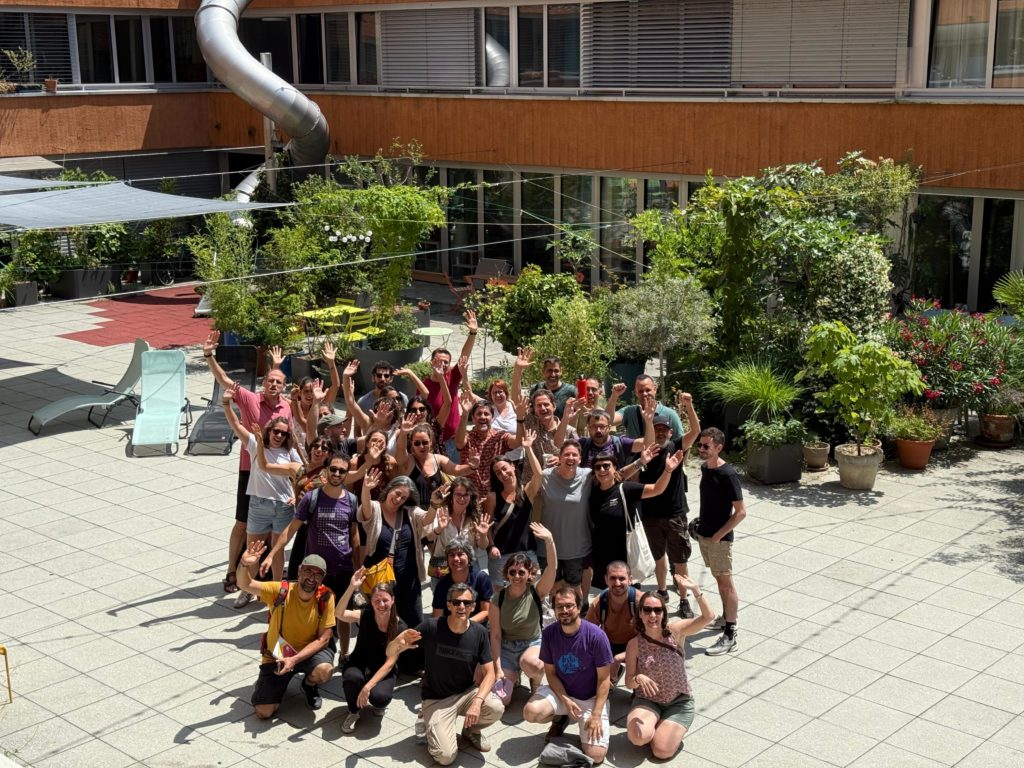
For three days, we got to know leading cooperative housing projects in Zurich and Geneva, hand in hand with their protagonists. We returned with inspiration and very concrete ideas to grow the model in Catalonia, knowing that it is possible to combine sustainability, affordable access, community management and scale.
In the last week of June, a delegation from Sostre Cívic we participated in a study visit to Switzerland to get to know one of the most advanced and consolidated cooperative housing models in Europe. The delegation was made up of members of the technical team, collaborators, and members of the Governing Council, also accompanied by some members of the cooperative group tangente of Madrid. The visit, organized by urbaMonde, a Franco-Swiss non-profit organization that promotes collaborative and community housing on an international scale, took us for three days to the cities of Zurich and Geneva. Both urban realities have different trajectories, but with a shared commitment to non-profit housing, cooperatives in right of use and citizen participation that underpin the right to housing.
A model with decades of experience
The Swiss context, characterized by a federal system with a high degree of autonomy for the cantons and municipalities, has favored the use of cooperatives as a key part of the housing stock. In cities such as Zurich or Geneva, more than 20% of housing is in the hands of cooperatives or non-profit foundations, and there are specific laws and favorable public and bank financing that make it possible.
The Swiss cooperative model has centuries-old roots and has been actively promoted by municipalities and cantons through the transfer of land and the creation of specific laws. It is also important to highlight the support of cooperatives issuing bonds (such as the Bond Issuing Cooperative) and the federations, which bring together more than 1.200 cooperatives and play a key role in training, advice and political advocacy. In Zurich, 20% of the population lives in cooperative housing, and the user fees are, on average, 30-40% lower than market prices. The model combines democratic autonomy, non-profit and reinvestment of surpluses in new projects and adequate maintenance of the buildings. Despite its success, it faces new challenges such as the increase in construction costs, the renovation of the old stock and adaptation to social diversity.

Leading cooperatives in typological and environmental innovation
In Zurich, we visited the cooperative Mehr als Wohnen, which manages the entire neighborhood of Hunziker, with 13 buildings and more than 1.200 residents, and incorporates innovative architecture, shared spaces and decarbonization strategies. We also saw Kalkbreite, with 90 homes and commercial spaces, an example of urban integration and permeability between public and private spaces.
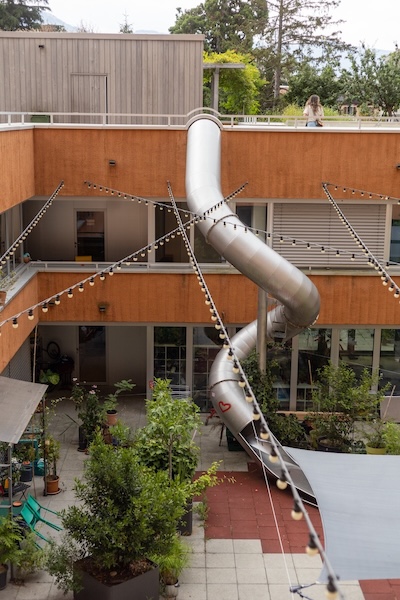
In Genève, we met with the local federation of cooperatives, the Groupement des coopératives d’habitation genevoises (GCHG), the solidarity economy network réseau APRÈS-GE, and met CODHA as Sostre Cívic, is a housing cooperative that manages multiple projects in a single organization under the use transfer model. CODHA has more than 7.000 members, 800 homes in 19 buildings and 12 projects in development. One of them, Jonction Écoquartier – Écojonx,is a set of 100 homes that stands out for its energy efficiency, sustainable mobility (only those who do not have a private car can live there) and self-management of the common and outdoor spaces (up to 1000 m²). Among these, it has an urban garden, different multipurpose and games rooms, DIY, storage rooms, guest bedrooms and even a slide that goes down about three floors, from the garden to the interior patio!
In the neighborhood of Vieusseux, we visited Soubeyran, a building of 38 homes promoted by the cooperativeÉquilibre (which also, like Sostre Cívic, manages several projects) and the works of Archipel, with 20 homes. The latter is part of a mostly private urban development operation that, thanks to local regulations, has made it possible to include this cooperative initiative. Both projects contain innovative ecological systems, such as straw bale insulation and 100% composting of wastewater with a worm-based composting system and recycling of urine for agricultural use.
Another highlight was the new eco-neighborhood of Les Vergers de Meyrin, with more than 1.300 homes spread over 30 buildings, most of which are managed by up to seven different cooperatives. A benchmark for how collaboration between cooperatives and administration allows the promotion of entire neighborhoods with affordable housing, shared infrastructures and high architectural and environmental quality. We visited Voisinage managed by CODHA, two buildings with 120 homes) and Équilibre (three buildings with 70 homes), which stand out for the large number of shared spaces (gym, climbing wall, laundries, and other multipurpose rooms, in addition to numerous community activities open to the neighborhood such as theaters, farms, circus, etc.), environmental quality and participatory processes. We also learned about La Ciguë, a student cooperative linked to CODHA, with clusters of 2 to 15 people and a horizontal participation structure, which facilitates access for young people and trains future cooperative members.

Clusters: community coexistence with shared spaces
One of the innovations we observed in several Swiss cooperatives is the implementation of housing clusters, a form of collective coexistence that combines private spaces with common spaces within the same home or floor. This model seeks to promote community life without giving up privacy, and is especially useful for diverse groups such as young people, the elderly or families with flexible structures. This model, for example, is what we are implementing in some of our projects such as Can 70.
In Mehr als Wohnen, for example, we visited housing with clusters of between 8 and 10 people per unit, organised in floors of up to 20 residents, with shared kitchens and common living spaces, while maintaining independent rooms, most with bathrooms and small independent kitchens. In Écojonx et Archipel, we also saw similar formats, with clusters that combine minimal private spaces and large common areas, such as dining rooms, laundry rooms or care spaces. In La Ciguë, the student cooperative, the clusters are the core of the project: shared apartments for 2 to 15 people, with highly participatory structures and direct community management of the space.

Keys to growing the model in Catalonia
In addition to inspiring us, the visit has shown us some keys to effectively scaling the cooperative model in Catalonia:
- The cession of public land, always long-term (75-100 years), it is a structural and essential system to guarantee viability.
- The public and bank loans cover up to 95% of the cost, with endorsement and anticipation before the license.
- Entry into new projects is facilitated with refundable grants to the initial share capital of the partners.
We also saw how Swiss cooperatives have a stable technical structure, advocacy capacity and strong federations that act as key interlocutors with administrations.
Returning from Switzerland has been a jolt of enthusiasm and ambition. If we want to grow the cooperative housing model in right of use in Catalonia, we need to act as a sector, ask for more and better public support and share knowledge. What is now a consolidated reality in Switzerland began, like us, with the impetus of social movements and the defense of housing as a right and not as a commodity.
Now it’s time to transform these learnings into action. Sostre Cívic We’re back with more tools, alliances and ideas to make it possible.