The support programme for the Senegalese Federation of Inhabitants aims to develop the urban planning and housing improvement capacity of the inhabitants of the precarious neighbourhoods of the Dakar suburbs.
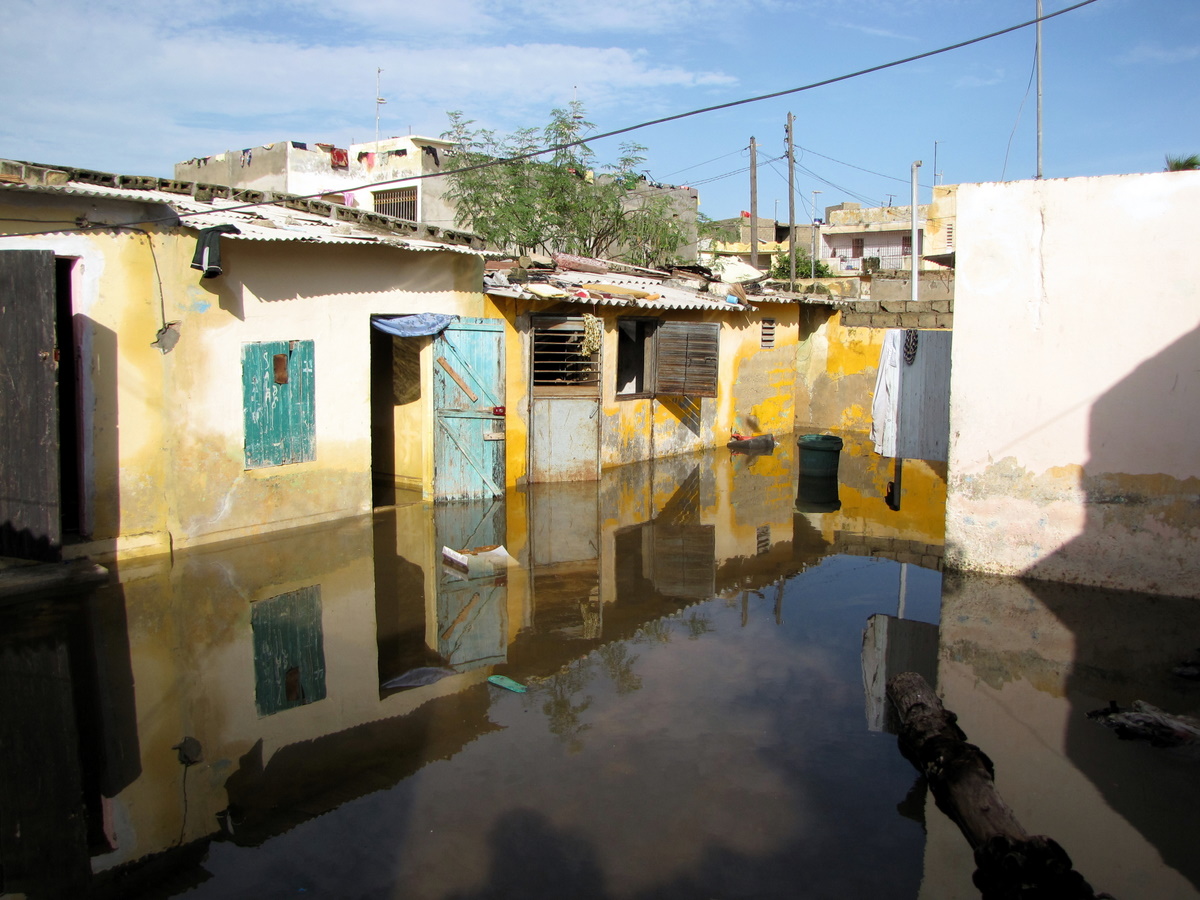
Since the end of the 1980s, the suburbs of Dakar have suffered recurrent flooding, causing considerable damage, particularly in the commune of Djiddah Thiaroye Kao (DTK), and in other communes in the suburbs.
For almost 20 years, some housing areas remained flooded for several months of the year, forcing part of the population to abandon their homes, to rebuild them, or to live in particularly precarious conditions with significant health risks.
From 2007 onwards, urbaMonde joined forces with local actors – residents organized in a collective of associations (CADDTK), as well as Senegalese urban professionals who had been looking for sustainable solutions to recurrent floods since 2005 – to strengthen the planning, prevention, and flood risk management capacities of the inhabitants of precarious districts.
This collaboration has given rise to a participatory planning process for the city of DTK and the emergence of a citizens’ movement organised in the Senegalese Federation of Inhabitants (FSH) and its NGO technical support, urbaSEN.
This federation of residents now has nearly 13,000 members organised in 580 savings groups, mostly women (96%), and is established in some fifteen communes in the suburbs of Dakar and in the regions of Thiès, Louga, and Ziguinchor. It is a member of Slum Dwellers International, a network of slum dwellers present in 32 countries across Africa, Asia, and Latin America.
The FSH calls for local, participatory urban governance and fills a real gap in the chain of city-building: the participation of inhabitants. Indeed, the expectations and needs of the populations of the irregular districts were only partially taken into account, and the inhabitants were not listened to.
2010 – 2013 Reducing water and land risks through concerted planning of the DTK commune
From 2005, the state launched an emergency plan, the Jaxaay plan, which aimed to rehouse the populations affected by the floods in a new housing estate located 30 km from Dakar and to build retention basins on the freed-up land. However, this project proved insufficient and sometimes out of touch with needs: some members of the population were not taken care of, and some inhabitants opposed the rehousing. Residents then mobilised to find sustainable solutions to this social, urban, and environmental problem.
With the support of a local technical team and urbaMonde, the flood-affected populations then set up the UrbaDTK1 project, which aimed to support the restructuring of irregular neighbourhoods in the commune of Djiddah Thiaroye Kao, one of the communes most affected by the floods, through participatory urban planning focusing primarily on the management of hydraulic risks and land security.
Considerable efforts have been made to strengthen local capacities in urban planning and water infrastructure and to unite residents around urban issues. At the same time, urban professionals and residents have been lobbying at all levels of the Senegalese government to improve understanding of the origin and causes of flooding and to propose solutions.
The UrbaDTK 1 project has enabled the formalisation of residents’ proposals in an urban development plan and a priority investment plan for the municipality of DTK, and has reduced land risk through a land register and a municipal census. The project also enabled the establishment of a Municipal Urban Planning Office (BMU), the first in Senegal, bringing real urban planning skills to the DTK Town Hall. Until then, the municipality, which has more than 150,000 inhabitants, did not have a municipal map. UrbaSEN and the BMU coordinated a large-scale field survey, enabling the identification and mapping of more than 6,000 plots.
2014 – 2017 Rebuilding 200 flooded houses in the commune of DTK
The participatory urban planning carried out during the UrbaDTK1 project proposed a series of measures to improve the living conditions of the inhabitants of the DTK municipality, particularly to better control the risk of flooding and keep inhabited areas out of the water. While some of these measures required significant state investments and were beyond the scope of municipalities and residents’ groups, the UrbaDTK_2 project aimed to support civil society in ensuring sustainable housing reconstruction.
It was intended to provide solutions for accessing affordable financing and technical support for the inhabitants of precarious neighbourhoods. Faced with the lack of housing improvement solutions, particularly for homes damaged by flooding, it was therefore the citizen action structured by the FSH and supervised by professionals that came to link and extend the State’s action in the precarious neighbourhoods.
Reconstruction and housing improvement projects are relatively modest, with little architectural pretension and little impact on the landscape, but with a strong social impact. The projects are formulated by members of the savings groups affiliated to the FSH, and validated by the FSH and its credit committee.
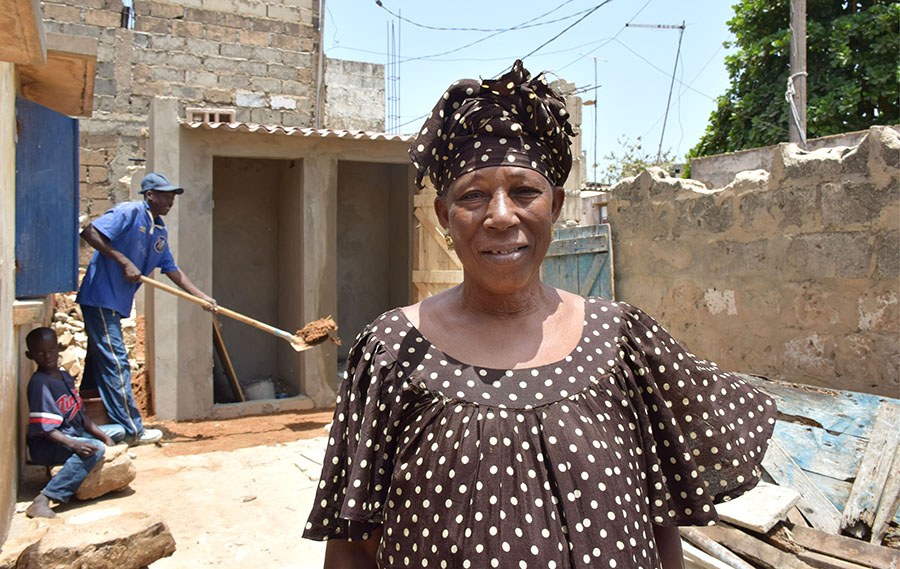
Each site is accompanied by urbaSEN’s technical team throughout the costing, monitoring, and acceptance process. 213 low-income households benefited from the UrbaDTK2 project by obtaining financing from the FSH revolving fund to rebuild their homes, with technical support from urbaSEN.
2018 – 2021 Consolidate the Senegalese Federation of Inhabitants and improve 400 homes
The FSH mobilises and federates its members to make their voices heard with public authorities and to defend their interests regarding access to decent and sustainable housing. It takes care of all community aspects, such as information sharing, admission of new groups, and beneficiary selection, within the framework of projects aimed at improving the living environment of people living in precarious urban areas.
The innovation lies in pooling savings at the federation level. This pooling enables funding the revolving fund for reconstruction, which aims to be sustainable. It requires and at the same time raises awareness among the members of the Federation that together they have greater power to act: Mbolo Mooy Dole, Union is Strength, is its slogan.
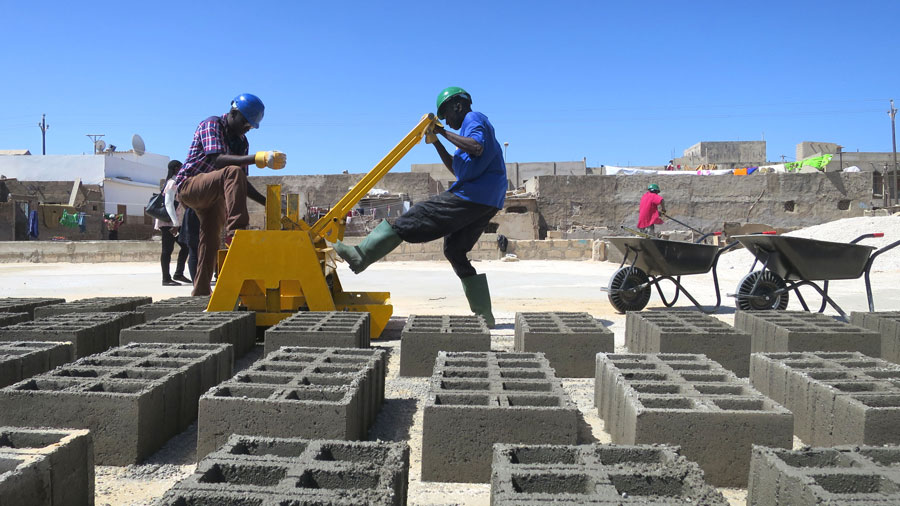
UrbaSEN and the FSH also manage a neighbourhood brickworks supplying ongoing building sites, enabling the production of high-quality building materials at a favourable price and promoting the training of local craftsmen. In addition, technical training is provided to craftsmen and members of residents’ groups, who are responsible for monitoring the construction site and warning of any problems.
Since 2015, the FSH has been a member of the Slum Dwellers International (SDI) network, a voice for the urban poor in 32 countries, organised in federations of savings groups. The « SDI model », which mobilises the urban poor to improve their housing through solidarity savings rituals, data collection, and political advocacy, has strongly inspired the creation of the FSH and the vision of urbaSEN as a technical assistance organisation at the service of the inhabitants.
The Dakar suburbs from the sky
A movie about the FSH – Mbolo Moy Dole – the Union Makes Strength!
This film traces the story of the urbaSEN and the Senegalese Federation of Inhabitants in Dakar. Hit by violent floods, precarious inhabitants are organised to address many urban problems and improve their habitat.
2023 – World Habitat Award
UrbaSEN and the Senegalese Federation of the Inhabitants received the 2023 World Habitat Award. This award, organised by World Habitat, is the world’s main housing prize. The winner receives £ 10,000 and has the opportunity to participate in international development projects.
How does the FSH work?
▶ other videos on the YouTube channel of our partner urbaSEN
The Senegalese Federation of Inhabitants in « Sous les toits du monde » (Under the roofs of the world)