Improving flood resilience in the Dakar suburbs
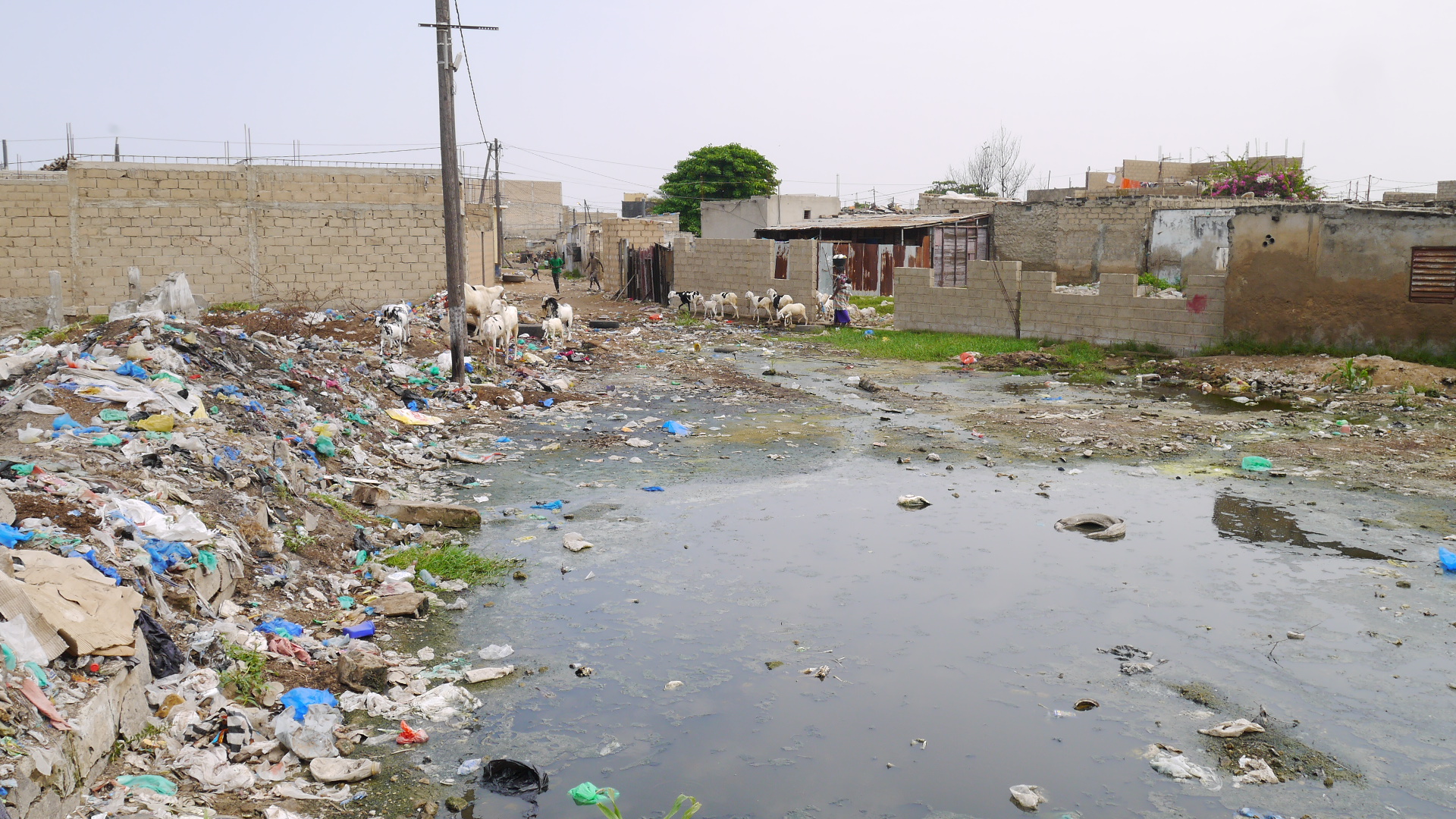
In the suburbs of Dakar, flooding has developed over the last three decades as a result of several factors: demographic growth and rural exodus leading to the spontaneous occupation of former semi-wetlands; the end of groundwater pumping for water supply due to pollution; the end of the « great Sahelian drought » of the 1970s, and the gradual return to normal rainfall.
The issue of flooding has risen on the political agenda, and the responses provided by the public authorities have diversified: emergency measures, evacuation and/or resettlement of affected neighbourhoods, construction of drainage networks and basins, possibly coupled with the restructuring of informal settlements. More recently, ’integrated management’ projects combine planning, design, and implementation of infrastructure and capacity building of public actors.
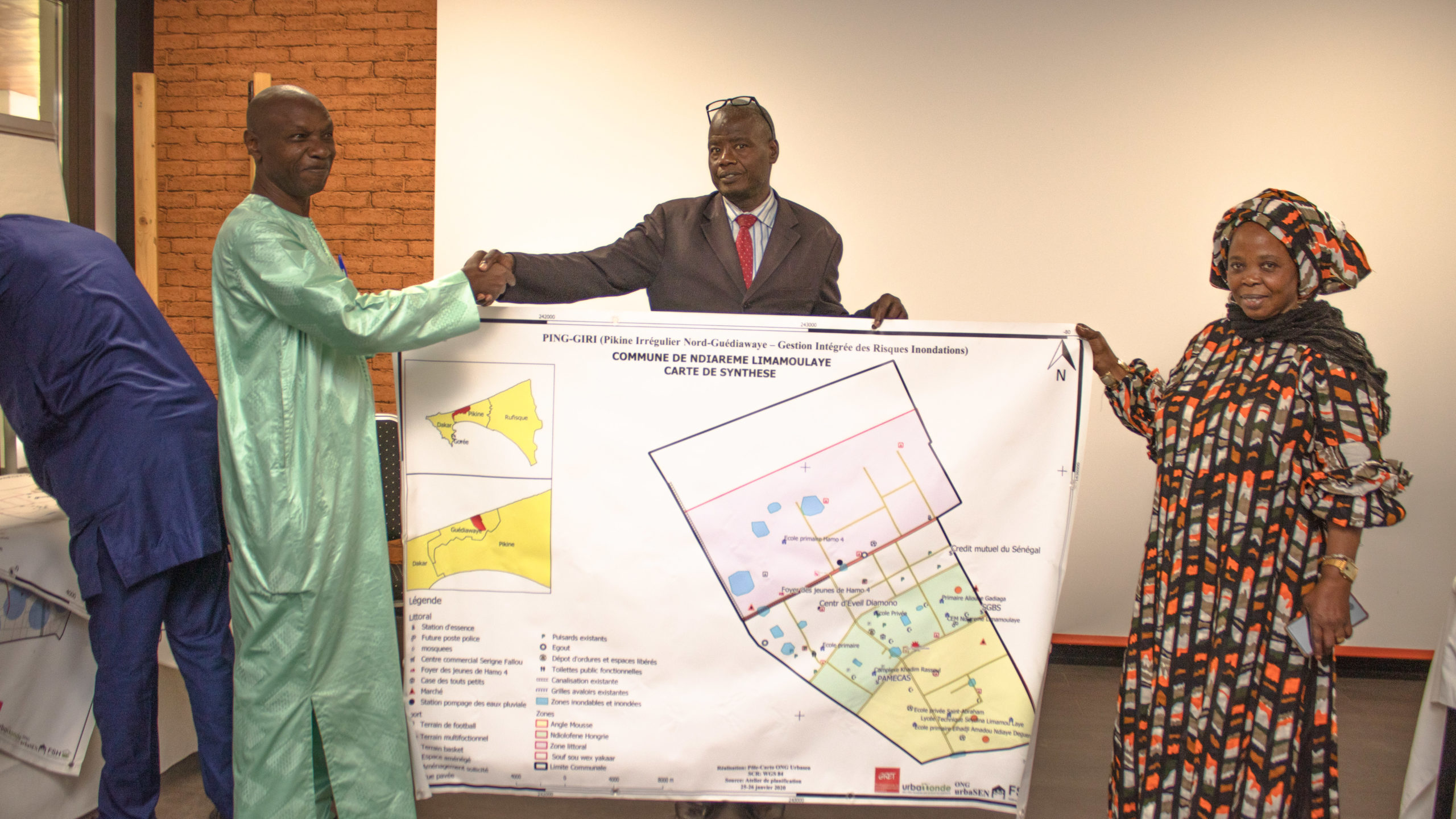
Nevertheless, support measures to improve and reconstruct individual housing affected by floods are rare or non-existent in Senegal. The Integrated Flood Risk Management projects (PING-GIRI) aim to extend the logic of intervention on housing (carried out within the framework of the housing renovation/rehabilitation programme) to community works co-designed by the inhabitants, the neighbourhood, the local authorities, and the State’s technical services.
Several projects of this type have been carried out since 2019, to which urbaMonde has contributed. Like the current ASG–GIRI project (2024-2028), the PING-GIRI project (2019-2023) was led by GRET and funded by the French Development Agency, with additional funding from the Lyon Water Fund. Together, these projects will have covered a large part of the municipalities in the department of Pikine, in the suburbs of Dakar.
Both projects have positioned urbaSEN and FSH as partners in the field. urbaSEN manages housing renovations, sanitation facility construction, and rainwater management. FSH is responsible for raising awareness among the population to improve their capacity to respond to the risk of flooding, as well as mobilising residents in the targeted neighbourhoods to ensure their support for the initiative and, where appropriate, their financial participation in the cost of certain works.
GRET is responsible for overall management and technical design expertise for the works. urbaMonde, for its part, monitors the revolving fund for housing renovation and residents’ financial participation in the cost of collective works. urbaMonde also plays an active role in innovation in terms of digital tools applied to these two projects (resident database and mapping, « Inondations Dakar » platform) and in leading the capitalisation process.
Following the first PING-GIRI project and capitalising on the lessons learned, urbaMonde has taken the lead in conducting a new integrated flood risk management initiative focused on the municipalities of Wakhinane Nimzatt and Ndiarème Limamoulaye, to be rolled out from 2024 to 2026.
Overall, Integrated Flood Risk Management is an innovative approach that involves measures to anticipate flood risk (adapting housing, participatory planning, raising awareness, and setting up early warning systems before rainfall), the construction of semi-collective and public wastewater and rainwater drainage infrastructure, and, finally, the preservation of structures through sustainable and shared management.
The project is backed by the FSH revolving fund, which provides loans to finance residents’ financial participation in projects at both the family and neighbourhood levels. This is the first time that this community savings tool has been used to co-finance collective and public works.
The advantage of this approach is that, thanks to their financial contribution, residents are fully involved in decision-making regarding the works to be carried out. They thus become full participants in the project, as financiers and managers of the works.
In a global context where residents of informal settlements in large cities are among those most exposed to climate risks, the GIRI approach gives them a central role as experts in their neighbourhoods, able to actively contribute to identifying problems, finding solutions, and ensuring their sustainability.